Introduction
Dogs need more than walks, meals, and a comfortable place to sleep. Their brains need opportunities to sniff, search, lick, chew, explore, and solve simple problems. That is where DIY pet enrichment toys can make everyday life more interesting without requiring a large budget or complicated equipment.
A homemade enrichment activity can be as simple as hiding kibble inside fleece strips, freezing a food-filled KONG, or turning a clean cardboard box into a supervised digging and discovery game. The goal is not to create the most complicated toy. It is to give your dog an appropriate way to perform natural behaviors while keeping the activity safe and enjoyable.
The ASPCA recommends enrichment that allows dogs to engage in behaviors such as sniffing, chewing, scavenging, and playing, while emphasizing close supervision when homemade items are available.
In this guide, we will explore three practical DIY pet enrichment toys: snuffle mats, frozen KONGs, and cardboard castles. You will also learn how to adapt each activity to your dog’s personality, chewing habits, and experience level.
Why DIY Pet Enrichment Toys Matter
Enrichment is not simply about keeping a dog occupied while you are busy. Good enrichment gives a dog something meaningful to do.
Dogs naturally investigate their surroundings with their noses and mouths. A food puzzle can turn an ordinary meal into a small foraging experience. A cardboard activity can give a dog an appropriate opportunity to investigate and shred. A frozen food toy can encourage licking and persistence.


This mental engagement can complement physical exercise and training. The ASPCA notes that regular enrichment allows dogs to engage in innate behaviors and can help reduce boredom-related unwanted behaviors.
The best DIY pet enrichment toys also have another advantage: they can be adjusted. If your dog solves an activity immediately, you can make it slightly more challenging. If your dog becomes frustrated, you can simplify it.
That flexibility is more valuable than making a puzzle unnecessarily complicated.
How to Choose the Right DIY Pet Enrichment Toys
Before making anything, think about how your dog actually behaves with objects.
A dog that gently sniffs and paws at things may enjoy a fabric-based activity. A persistent food lover may prefer a frozen food toy. A dog that loves investigating boxes may enjoy a cardboard castle.
However, a dog that immediately eats fabric, cardboard, or other materials needs a different type of enrichment.
Homemade does not automatically mean safe. Materials should be inspected for staples, tape, sharp edges, loose pieces, plastic fragments, strings, or anything small enough to swallow. Damaged toys should be removed promptly.
Your dog’s size also matters. An opening, container, or toy that works for one dog may not be appropriate for another. Always consider the dog’s mouth size, chewing strength, and history of swallowing non-food objects.
DIY Snuffle Mats: Turn Mealtime Into a Scent Game
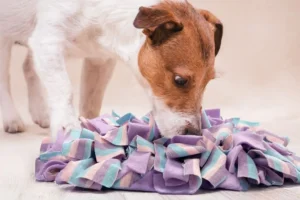
A snuffle mat is one of the simplest DIY pet enrichment toys to create. Its basic purpose is to encourage a dog to use its nose to locate pieces of food hidden among fabric strips.
This makes a regular meal more interactive. Instead of simply eating from a bowl, your dog has to search, sniff, and work out where individual pieces are hiding.
How to Make a Simple Snuffle Mat
You can create a basic version using a suitable rubber mat and strips of fleece. Tie the fabric securely through the openings until you have enough material to create plenty of places for kibble to hide.
The finished mat should be stable and should not contain loose pieces that your dog can easily pull off and swallow.
Once the mat is ready, scatter a portion of your dog’s normal kibble throughout the fabric. Start by placing some pieces near the surface so your dog quickly understands the game.
There is no need to make the first session difficult.
The ASPCA also describes homemade snuffle mats using fleece strips attached to a mat, with kibble hidden throughout the fabric.
How to Make the Snuffle Mat More Challenging
Once your dog understands the activity, you can gradually hide food deeper within the fabric.
You can also vary the location of the food rather than putting it in the same areas every time. This encourages genuine searching rather than memorizing a pattern.
However, difficulty should increase gradually. If your dog starts pawing frantically, biting the mat, or giving up, make the game easier.
The purpose of DIY pet enrichment toys is engagement, not frustration.
When a Snuffle Mat Is Not Appropriate
A snuffle mat requires supervision, particularly when your dog is still learning how to use one.
If your dog starts chewing and swallowing fabric instead of searching for food, remove the mat. Dogs that repeatedly ingest fabric may need a different enrichment approach.
The same principle applies to homemade enrichment generally: choose the activity according to the individual dog rather than assuming every DIY idea works for every pet.
Frozen KONGs: A Longer-Lasting Food Activity
Frozen KONGs are another popular option when you want DIY pet enrichment toys that can keep a dog engaged for longer.
The basic idea is simple. Fill a suitable KONG-style rubber toy with dog-safe food, then freeze it. Freezing makes the contents harder to remove, encouraging licking and persistence.
A frozen food toy can be especially useful when you want your dog to have a quiet activity after exercise or during a period when you need them occupied.
How to Prepare a Frozen KONG
Start with your dog’s regular food or another ingredient that you already know is appropriate for them.
You can moisten kibble and pack it into the toy, or use a small amount of plain dog-safe food as a binding layer. The opening should remain appropriate for your dog’s size, and the toy itself should be suitable for their chewing strength.
Place the filled toy in the freezer until the contents are solid.
If you are introducing a frozen KONG for the first time, you do not necessarily need to freeze it completely. A partially chilled filling can be easier for a beginner to access.
As your dog becomes comfortable with the activity, you can increase the challenge.
Wisconsin Humane Society similarly recommends frozen enrichment activities using food, treats, toys, and filled KONGs, noting that frozen activities change as they thaw.
What Can You Put in a Frozen KONG?
There are many possibilities, but simplicity is usually best.
You can use part of your dog’s regular kibble, wet dog food, mashed dog-safe vegetables, or another ingredient that fits their existing diet. If using extras, remember that treats and calorie-dense ingredients contribute to the dog’s overall daily intake.
Never assume that a food is safe simply because it is commonly used in online recipes. Avoid ingredients that are toxic to dogs, and check with your veterinarian if your dog has allergies, dietary restrictions, or a medical condition requiring a specific diet.
Why Freezing Makes a Difference
A soft filling can sometimes disappear quickly. Freezing changes its texture and makes the dog work longer to remove it.
That means the same toy can provide a different experience simply by changing how the food is prepared.
This is one reason frozen KONGs work well within a rotation of DIY pet enrichment toys. You do not always need a new object. Sometimes changing the texture is enough.
Cardboard Castles: A Simple Shredding and Searching Game
The cardboard castle is perhaps the most entertaining-looking of these DIY pet enrichment toys.
You can use a clean cardboard box and create a simple structure with openings, smaller boxes, or loosely arranged pieces of plain cardboard. The idea is to give your dog something to investigate and search rather than creating a complicated construction project.
Hide a small portion of kibble or treats in accessible areas and let your dog explore.
The activity can satisfy dogs that enjoy investigating, pawing, nosing, and controlled shredding.
How to Build a Cardboard Castle
Start with a clean, plain cardboard box whose previous contents are known.
Remove staples, tape, plastic, loose labels, handles, and other materials. Cut away sharp or awkward edges. Create large openings rather than narrow holes where a dog’s head or muzzle could become stuck.
You can place a few lightweight cardboard pieces inside the box and hide food among them.
Keep the first version simple.
As your dog learns the game, you can introduce another clean box or create additional accessible compartments. The activity should remain easy enough that your dog can make progress.
Is Cardboard Safe for Dogs?
This depends heavily on the individual dog.
Some dogs happily shred cardboard without swallowing it. Others immediately eat the pieces. Those are very different situations.
Current guidance on homemade dog enrichment emphasizes monitoring dogs closely and removing cardboard activities if the dog begins ingesting the material.
If your dog eats cardboard rather than simply investigating or shredding it, a cardboard castle is not an appropriate enrichment choice.
Do not try to make the box tougher to prevent destruction. The safer response is to choose another type of enrichment.
Making DIY Pet Enrichment Toys Safer
Safety should be part of the design rather than an afterthought.
Before giving your dog any homemade toy, inspect every component. Remove staples, string, elastic, plastic pieces, sharp edges, loose tape, and small parts.
Watch how your dog interacts with the object rather than assuming they will use it as intended.
For example, you might create a beautiful snuffle mat expecting your dog to sniff through the fleece. If your dog immediately starts ripping the fabric apart, the activity has changed from scent enrichment to a potential swallowing hazard.
The same applies to cardboard.
Active supervision means staying close enough to intervene when necessary. The ASPCA specifically recommends closely supervising dogs when DIY enrichment items are accessible and removing an item if the dog attempts to ingest it.
It is also important to stop using a homemade toy once it becomes damaged. A toy does not become safer simply because your dog has used it successfully several times.
How to Keep DIY Pet Enrichment Toys Interesting
You do not need to create a new toy every day.
Instead, rotate activities.
One day, your dog might use a snuffle mat during part of a meal. Another day, you could offer a frozen food toy. Later, you might provide a supervised cardboard investigation.
Changing the way food is presented can also make familiar activities feel new.
For example, you can make a snuffle mat easier or harder depending on your dog’s experience. A frozen KONG can use a different texture. A cardboard box can be made smaller or simpler.
Think about what your dog appears to enjoy.
Some dogs are enthusiastic sniffers. Others love licking. Some prefer manipulating objects with their paws, while others enjoy shredding.
The most effective DIY pet enrichment toys are those that match the dog’s natural interests.
Common Mistakes to Avoid
One common mistake is making enrichment too difficult.
A puzzle that looks impressive to humans may be frustrating for a dog. If the dog cannot understand how to access the reward, they may lose interest.
Another mistake is using too many treats.
Enrichment should fit into the dog’s overall feeding plan. Using some of the dog’s normal meal as the reward can be an easy way to provide enrichment without unnecessarily adding calories.
A third mistake is leaving DIY toys available after the useful part of the activity is finished.
For example, if a dog has emptied a snuffle mat but continues chewing the fabric, remove it. If the food is gone from a cardboard box and the dog begins eating cardboard, end the activity.
Finally, avoid copying complicated online DIY projects without considering your own dog’s behavior. A simple, supervised activity that your dog enjoys can be much more useful than an elaborate toy that creates unnecessary risks.
DIY Pet Enrichment Toys for Puppies, Adult Dogs and Seniors
The same basic concept can work across different life stages, but the activity should be adjusted.
Puppies often benefit from simple, low-frustration activities that encourage exploration. Their chewing habits and tendency to investigate objects with their mouths make supervision particularly important.
Adult dogs can usually handle more variation, depending on their chewing style and experience with food puzzles.
Senior dogs may still enjoy enrichment but may need easier access, softer food, shorter sessions, or activities that do not require excessive physical effort.
Your dog’s individual abilities matter more than their age alone.
If your dog has dental problems, dietary restrictions, mobility limitations, or a history of swallowing foreign objects, speak with your veterinarian about appropriate enrichment options.
Make Enrichment Part of Everyday Life
You do not need an expensive collection of puzzle toys to make your dog’s day more interesting. With a little creativity, ordinary materials can become engaging activities.
DIY pet enrichment toys such as snuffle mats, frozen KONGs, and cardboard castles give dogs different ways to sniff, search, lick, investigate, and problem-solve. The key is choosing an activity that fits your dog’s individual behavior and supervising it carefully.
Start with something simple today. Use part of your dog’s regular meal in a homemade snuffle mat, freeze an appropriate food-filled toy, or create a small cardboard discovery box if your dog can safely interact with cardboard.
FAQs
Are DIY pet enrichment toys safe for dogs?
They can be safe when the materials, activity, and difficulty are appropriate for the individual dog. Homemade does not automatically mean risk-free. Supervise the activity and remove any toy that becomes damaged or is being swallowed.
Are snuffle mats good for dogs?
Snuffle mats can provide opportunities for dogs to sniff and search for food, making meals more interactive. They are particularly useful for dogs that enjoy scent-based activities. However, the mat should be supervised, especially if the dog is inclined to chew or ingest fabric.
Can I let my dog chew on cardboard?
Some dogs can enjoy supervised cardboard shredding without consuming it. If your dog eats the cardboard, remove the activity and choose a different enrichment option. Ingesting larger pieces can create choking or gastrointestinal concerns.
How do you make a frozen KONG for a dog?
Fill an appropriately sized KONG-style rubber toy with suitable dog-safe food, then freeze it. Start with an easier filling for dogs that are new to the activity and gradually increase the challenge if they enjoy it. Frozen enrichment is also recommended by Wisconsin Humane Society as a way to make food-based activities last longer.
What can I put in a KONG to freeze?
You can use portions of your dog’s regular food or suitable dog-safe ingredients that fit their dietary needs. Avoid toxic ingredients and account for additional calories from treats or rich foods. Dogs with allergies or prescribed diets may need individualized guidance from a veterinarian.
How do I mentally stimulate my dog at home?
Food searches, snuffle mats, frozen food toys, scent games, training exercises, and supervised investigation activities can all provide mental stimulation. The ASPCA recommends enrichment that allows dogs to engage in natural behaviors such as sniffing, chewing, playing, and scavenging.